UX Case Study · Enterprise K–12 Platform
Accessibility Program Architecture
From Silence to System: Architecting Accessibility at Scale
1 → 25+
Accessibility contributors — from sole SME to cross-functional program
7
Designers trained in first cohort; became internal advocates
UX · QA · Eng · Product
Full cross-functional adoption across the organization
Program Architecture
Systemic infrastructure, not point fixes
01 — Overview
When Responsibility Became Infrastructure
The moment a practitioner becomes an architect
The Origin
In 2024, accessibility was not yet a structured initiative inside the organization. Federal regulatory pressure had increased urgency around compliance — but internally, accessibility was still treated as something reactive. Teams viewed it as a final-stage checklist item rather than a foundational part of product development.
At the time, I was the only accessibility subject matter expert across a department of more than 200 people.
I began as a practitioner — auditing interfaces, documenting issues, collaborating with developers, and validating fixes manually. But the scale of the problem exceeded what any single contributor could sustain. The product ecosystem spanned thousands of screens, multiple platforms, and highly complex workflows used by students, parents, teachers, and district administrators.
The challenge was no longer simply fixing accessibility issues. The challenge was creating a system capable of preventing them.
Role & Scope
This project became the turning point where my role evolved from UX practitioner into accessibility program architect — building organizational capability, operational systems, shared standards, and long-term cultural adoption.
02 — Empathize
Understanding the Gaps No One Could See
Experiencing failure before designing solutions
Product Accessibility Issues
Before defining solutions, I needed to understand where the failures truly existed. I began by experiencing the product through assistive technologies — screen readers, keyboard navigation, zoom testing, and color contrast validation.
The experience was fragmented and often unusable. Forms lacked accessible names. Navigation patterns broke keyboard flow. Semantic structure was inconsistent. Critical workflows could not be completed independently by users relying on assistive technology.
Organizational & Cultural Gaps
I immersed myself in the organization — observing design critiques, engineering workflows, QA processes, and product discussions. What I found was not active resistance, but a widespread absence of shared understanding.
| Discipline | Gap identified |
|---|---|
| Designers | Understood visual systems but not semantic structure |
| Engineers | Implemented patterns without understanding assistive technology behavior |
| QA Teams | Lacked accessibility validation criteria entirely |
| Leadership | Viewed accessibility as compliance, not design quality |
To bridge these gaps, I facilitated accessibility exposure sessions across departments — demonstrating broken screen reader experiences live. Accessibility stopped being theoretical. It became tangible.
Atomic Accessibility Research Framework
Turning testing into decisions — I adapted the Atomic Research model into an accessibility-specific framework. Rather than presenting disconnected accessibility bugs, findings were structured through four progressive layers, transforming accessibility from subjective feedback into actionable organizational decision-making.
Accessibility Testing Inputs
-
Manual Keyboard Testing
Validate complete non-mouse navigation across all flows
-
Screen Reader Testing
Evaluate semantic interpretation and announcement accuracy
-
Voice Control Testing
Assess command discoverability and label clarity
-
Color Contrast Validation
Ensure visual readability across all states
-
Zoom / Magnification Testing
Validate responsive scaling at 200–400%
-
Automated Scanning
Detect technical violations at scale across components
Atomic Research Examples
| Experiment | Fact | Insight | Recommendation |
|---|---|---|---|
| Screen reader testing on forms | 63% of inputs lacked accessible names | Users cannot complete forms confidently or independently | Standardize accessible naming patterns across all inputs |
| Navigation usability testing | 20% of users failed to locate key tasks | Navigation hierarchy lacks sufficient clarity | Redesign navigation structure with semantic headings |
| A/B testing labels and icons | 40% increase in task engagement with icons | Icons meaningfully improve comprehension | Expand icon-supported labeling across the system |
Figures shown are representative examples recreated for portfolio purposes.
03 — Define
Reframing Accessibility as a Systems Problem
Shifting from screens to systems
The Foundational Insight
Once I understood the scale of the problem, I shifted from thinking about screens to thinking about systems. The platform contained thousands of interfaces, making one-off remediation impossible at any meaningful pace.
If we remediate the ~30 core components, we can influence thousands of downstream experiences simultaneously.
I mapped the product into its underlying component architecture, categorizing issues across inputs and forms, navigation systems, data tables, validation patterns, structural hierarchy, and interactive states.
Component Ecosystem Map
| Layer | Description | Impact |
|---|---|---|
| Components (~30 core patterns) | Reusable UI building blocks | Remediation at this level cascades upward through all higher layers |
| Templates | Reusable layouts built from components | Inherit accessibility fixes automatically |
| Screens | Thousands of product views | Improved without screen-by-screen intervention |
| User Journeys | End-to-end flows | Accessible experiences delivered at scale |
Accessibility Responsibility Matrix
Alongside the component architecture, I defined the organizational infrastructure required to sustain accessibility long term. Accessibility stopped being a specialized initiative and became operational infrastructure.
| Discipline | Responsibilities |
|---|---|
| UX Design | Accessibility-first component design, semantic annotation, checklist adoption |
| Engineering | Semantic implementation, ARIA patterns, keyboard interaction models |
| QA | Accessibility acceptance criteria, screen reader validation, regression testing |
| Product | Accessibility in definition of done, roadmap prioritization, SDLC integration |
| Leadership | Reporting structures, compliance accountability, culture investment |
04 — Ideate
Scaling Through Capability Instead of Control
From dependency to distributed ownership
The Strategic Shift
Initially, I personally handled most remediation guidance. But centralizing expertise created a bottleneck. If accessibility relied solely on me, it would never scale.
Rather than scaling output, I focused on scaling capability. The goal: build a system that teaches people to fish.
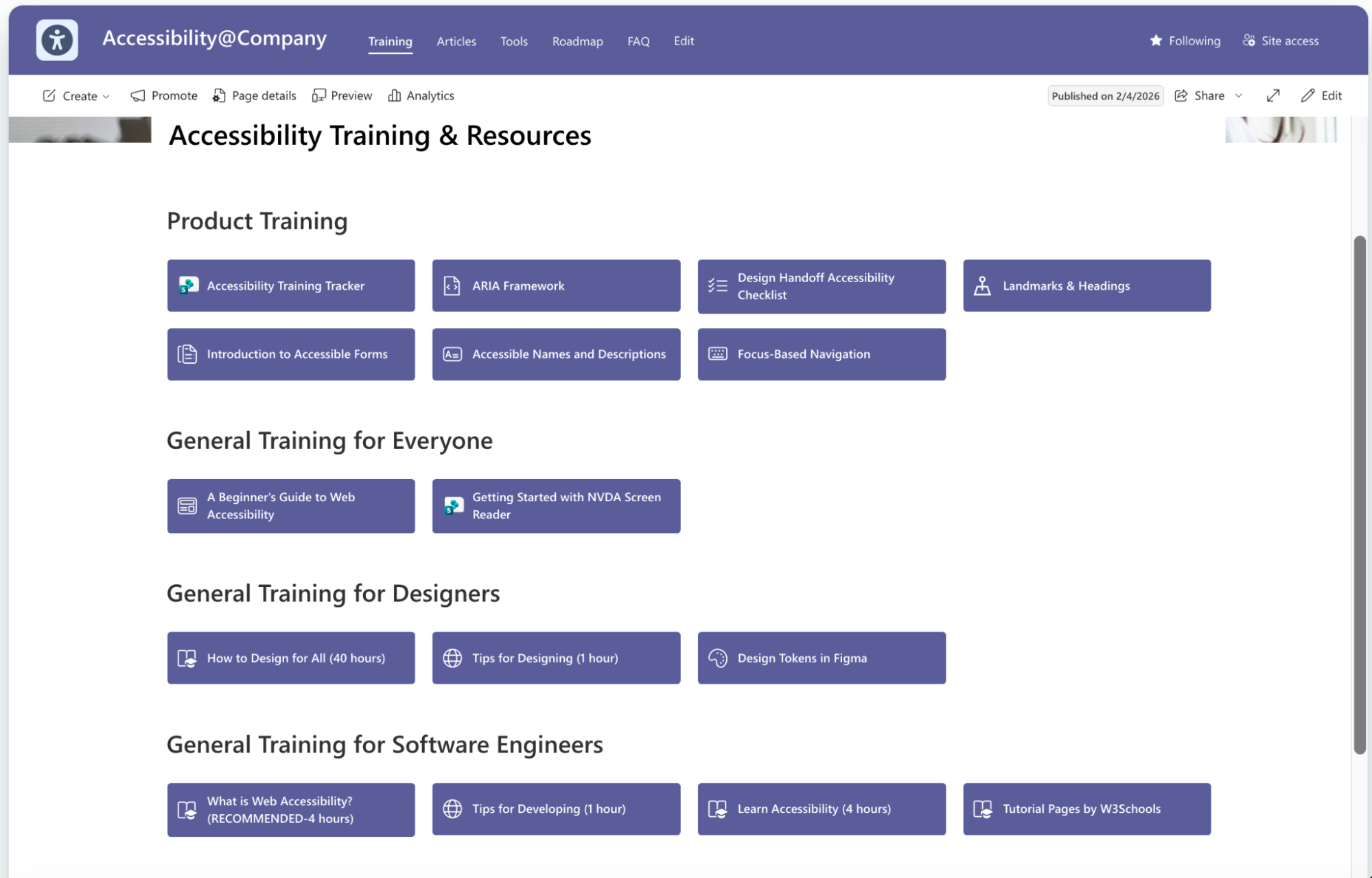
I designed a UX-centered accessibility training model tailored to the organization's workflows and design systems. The first cohort included seven designers who began with foundational accessibility education before participating in collaborative remediation workshops directly.
These workshops were intentionally hands-on. We reviewed live product components together, identified failures, discussed semantic intent, and explored implementation considerations collaboratively. The process revealed deeper organizational gaps — especially between design intent and engineering execution.
Those early participants became advocates themselves, accelerating broader organizational adoption.
Training Evolution Timeline
-
Phase 1
Audience
UX Designers
Outcome
Accessibility awareness and foundational knowledge
-
Phase 2
Audience
UX + Engineering + QA
Outcome
Shared standards and cross-functional language
-
Phase 3
Audience
Organization-wide
Outcome
Embedded accessibility culture and self-sufficiency
05 — Prototype
Building the Infrastructure for Scale
The program itself was the prototype
What Was Built
The prototype in this project was not a screen. It was the program itself — a suite of tools, systems, and documentation structures designed to outlast any single contributor.
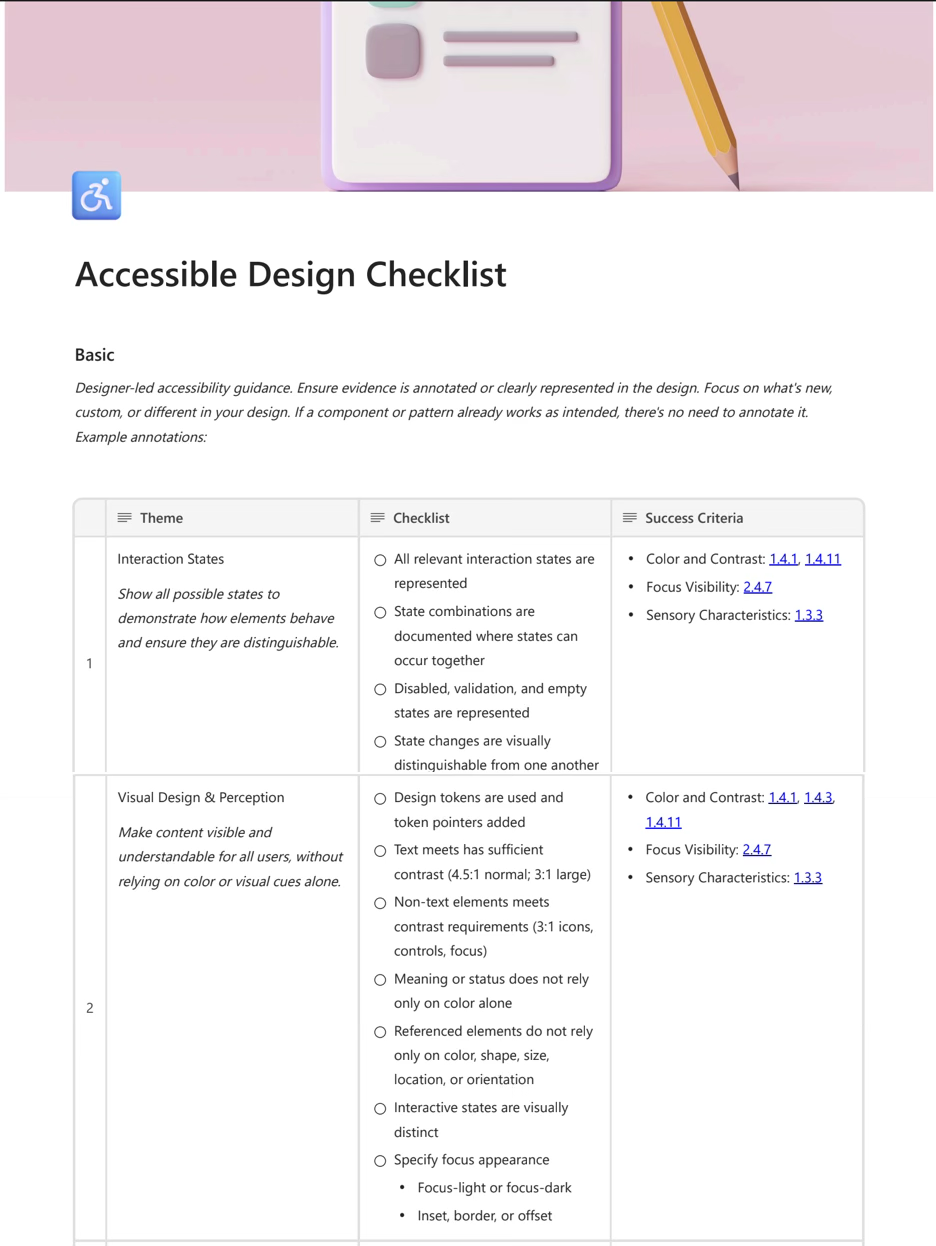
- Accessibility Design Checklists — Reframed around UX workflows, not WCAG terminology
- Annotated Figma Examples — Pattern library of accessible implementations with annotations
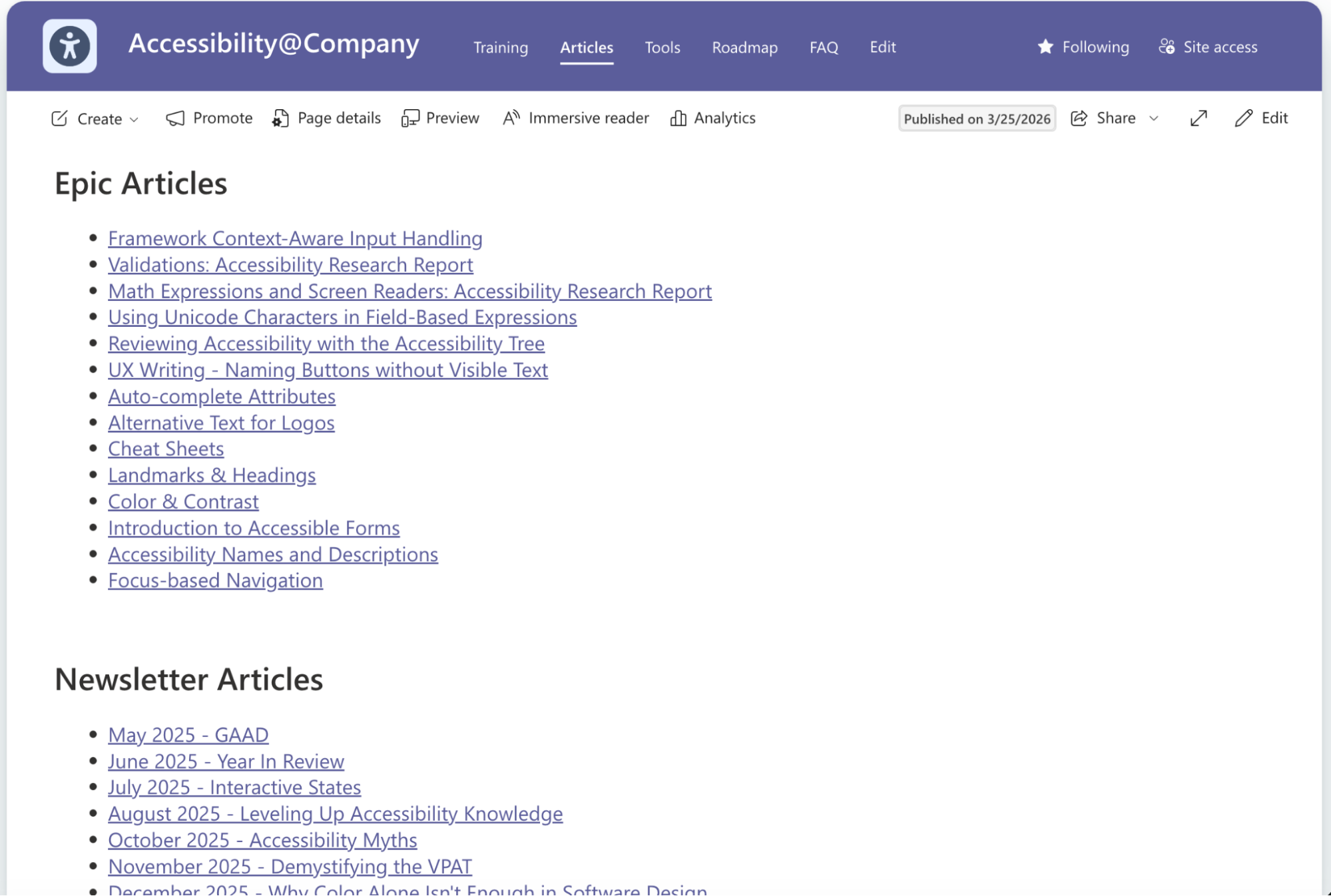
- Accessibility Documentation Hubs — Centralized shared knowledge, searchable by stage and component
- Testing Workflows — Step-by-step QA processes integrated into sprint ceremonies
- Training Materials — Role-specific modules for Design, Engineering, and QA
- Monthly Accessibility Newsletters — Keeping accessibility visible across the organization
- Shared Remediation Standards — Common language and criteria used across all disciplines
Accessibility Checklist Design
Rather than organizing guidance around WCAG terminology, the checklist was reframed around actual UX workflows and deliverables — making accessibility a natural part of existing design behaviors rather than a layer added afterward.
| Design Stage | Checklist Focus Areas |
|---|---|
| Exploration | Content hierarchy, semantic structure, heading levels, landmark regions |
| Refinement | Interaction states, focus management, accessible naming, labels |
| Handoff | Keyboard behavior, ARIA annotations, engineering implementation notes |
Leadership Recognition
Leadership feedback recognized Lead UX-level ownership — defining and driving adoption of the Accessibility Design Checklist, with cross-functional influence, systems-level thinking, and long-term organizational capability building.
— Paraphrased from UX leadership feedback06 — Test
Embedding Accessibility Into Everyday Delivery
From program adoption to cultural standard
Behavior Change Across Teams
As the program matured, accessibility became embedded into daily operations — not as a separate workstream but as an integrated quality standard across every discipline.
| Team | Change |
|---|---|
| QA Teams | Adopted accessibility acceptance criteria as standard sprint gates |
| Designers | Began proactively identifying concerns before development began |
| Engineers | Started considering semantic implementation in early technical planning |
The Language Inside the Organization Changed
Before
- "Does this look right?"
After
- "Is this keyboard navigable?"
- "Does this have an accessible name?"
- "Will a screen reader announce this correctly?"
That shift represented true cultural adoption. Accessibility had moved from external requirement to shared design quality standard.
Adoption Growth
-
1 SME
Program Launch
-
7 Designers
Phase 1 Training
-
25+ Contributors
Full Org Adoption
Growth from one isolated subject matter expert to 25+ active contributors spanning UX, Engineering, QA, and Product.
07 — Outcomes & Key Learnings
Designing Systems That Continue Without Me
Sustainability as the true measure of impact
Summary of Impact
Within two years, accessibility evolved from a fragmented responsibility into a scalable organizational capability. The outcomes below represent systemic change — not individual heroics.
- Accessibility integrated into SDLC — Built into sprint ceremonies, not bolted on at the end
- 25+ trained contributors — Across UX, Engineering, QA, and Product functions
- Standardized remediation frameworks — Consistent criteria used organization-wide
- Shared knowledge systems — Documentation hubs that remain operational without ongoing maintenance
- Design system governance — Accessibility-aware component standards embedded at the source
Most importantly, the system became sustainable. If I left tomorrow — the training, documentation, standards, and workflows would all continue.
Key Learnings
-
Scale through systems, not heroics — One expert cannot audit, fix, and maintain an enterprise product indefinitely. Systems, standards, and shared language are the only paths to scale.
-
Empathy precedes adoption — Live demonstrations of broken screen reader experiences changed minds faster than compliance arguments ever could.
-
Reframe around workflows, not regulations — Accessibility checklists organized by design stage — not WCAG criteria — achieved adoption because they matched how designers already work.
-
Build advocates, not dependencies — Training early participants to become internal advocates created an organic multiplication effect that no centralized program could replicate.
-
Sustainability is the final deliverable — The measure of program success is not what exists while you're there — it's what continues when you're gone.
Accessibility at scale is not achieved through expertise alone. It is achieved by building systems, shared language, and organizational capability that allow inclusive design to continue beyond any one individual.